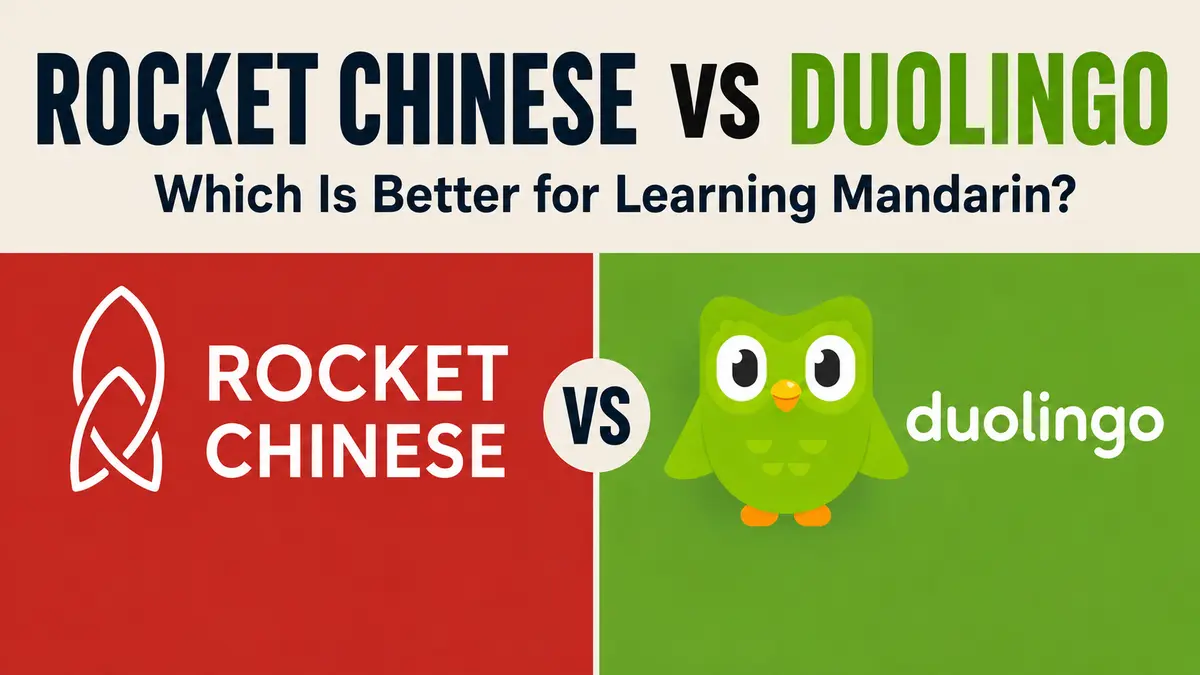
If you are comparing Rocket Chinese vs Duolingo, you are probably trying to answer one simple question: which course will actually help you learn Mandarin?
Both platforms can help beginners, but they are designed for very different types of learners.
Duolingo uses short, game-like lessons to make daily practice easy. It is useful for building vocabulary, recognising basic sentence patterns and developing a consistent study habit.
Rocket Chinese is a more complete, structured course. It places greater emphasis on listening, speaking, pronunciation, grammar and practical conversations.
So which one is better?
Duolingo is the better choice for free, casual daily practice. Rocket Chinese is the stronger choice for learners who want a structured path towards real Mandarin conversations.
Rocket Chinese vs Duolingo: The Quick Answer
Choose Duolingo if you:
- want to start learning Mandarin for free
- enjoy games, points, streaks and short lessons
- want to build a daily learning habit
- mainly want beginner vocabulary practice
- are still deciding whether Mandarin is right for you
Choose Rocket Chinese if you:
- want to speak and understand Mandarin in real situations
- prefer a clear, structured learning path
- want more listening and pronunciation practice
- need grammar explained in plain English
- want cultural notes and practical dialogues
- are prepared to invest more time in each lesson
At a Glance
Best for casual beginners: Duolingo
Best for speaking practice: Rocket Chinese
Best for listening practice: Rocket Chinese
Best for grammar explanations: Rocket Chinese
Best for gamification: Duolingo
Best free option: Duolingo
Best structured course: Rocket Chinese
Best for long-term conversational progress: Rocket Chinese
This stacked comparison is intentionally simple. The important difference is not the number of features each platform offers. It is the kind of learning each platform encourages.
My Experience With Duolingo
I used Duolingo for about two years.
It helped me build a daily study habit. I learned vocabulary, became familiar with some Chinese characters and started recognising basic sentence patterns.
But after two years, I still did not feel confident speaking Mandarin with a real person.
That was an important lesson for me.
Completing exercises inside an app is not the same as following a conversation, producing a sentence quickly or being understood by a native Mandarin speaker.
Duolingo helped me begin, and I do not consider that time wasted. However, I eventually realised that I needed more listening, speaking and practical conversation practice.
Speaking Practice
Speaking is where many Mandarin learners struggle.
You may recognise hundreds of words on a screen but still freeze when somebody asks you a simple question. Your brain has learned to identify the answer, but it has not necessarily learned to produce Mandarin in real time.
Rocket Chinese
Rocket Chinese puts speaking near the centre of the course.
Its lessons include native-speaker audio, pronunciation practice, role-playing activities and voice-recognition exercises. You are regularly encouraged to repeat phrases and answer aloud instead of only selecting an answer.
This is particularly useful for Mandarin because pronunciation and tones affect meaning. Knowing the right word is not always enough if the listener cannot recognise the way you pronounce it.
Voice recognition is not a substitute for feedback from a teacher or native speaker, but it can encourage beginners to speak more often and notice differences in their pronunciation.
Duolingo
Duolingo includes listening and some speaking activities, although the exact exercises can vary by device, account and course version.
Most of the experience still revolves around short exercises such as matching words, selecting answers, arranging sentences and translating phrases.
These activities can reinforce vocabulary, but they do not provide the same amount of extended speaking practice as Rocket Chinese.
Winner for speaking: Rocket Chinese
Listening and Pronunciation
Listening to Mandarin can feel extremely difficult at first.
Native speakers do not leave clear spaces between words. Tones can be hard to distinguish, and familiar vocabulary may sound completely different inside a fast sentence.
Rocket Chinese
Rocket Chinese uses longer interactive audio lessons built around conversations and everyday situations.
You hear native speakers, listen to explanations and repeatedly practise useful phrases. This gives you more time with spoken Mandarin and helps connect individual words to complete sentences.
The course also lets you compare your pronunciation with recorded native audio.
Duolingo
Duolingo provides useful listening exercises and usually allows learners to replay audio. Some exercises also offer a slower playback option.
This works well for recognising beginner vocabulary and short sentences. However, the audio practice is generally more exercise-based and less like following an extended conversation.
Winner for listening and pronunciation: Rocket Chinese
Grammar and Sentence Structure
Mandarin grammar is often described as simple because Chinese does not conjugate verbs in the same way as English.
However, Mandarin sentence order, aspect markers, measure words and particles can still be confusing. Beginners need to understand why a sentence is formed in a particular way—not just whether they selected the correct answer.
Rocket Chinese
Rocket Chinese provides more detailed explanations in English.
The course explains sentence patterns and then gives you opportunities to hear and use them. This makes it easier to adapt a pattern and create your own sentences later.
Duolingo
Duolingo teaches many patterns through repetition and examples. Some learners enjoy discovering the rules as they progress, while others find the limited explanations frustrating.
It can help you recognise common structures, but you may need another grammar resource when you want to understand why a particular answer is correct.
Winner for grammar: Rocket Chinese
Chinese Characters, Reading and Writing
Learning Mandarin also means becoming familiar with Hanzi, the Chinese writing system.
Neither platform should be your only resource if your goal is advanced Chinese reading and handwriting, but both can help beginners connect spoken words with written characters.
Rocket Chinese
Rocket Chinese introduces characters alongside vocabulary and includes reading and writing activities within a broader course.
Its main advantage is context. You are learning how a word sounds, what it means and how it fits into a sentence—not only trying to recognise its written form.
Duolingo
Duolingo provides frequent exposure to Chinese characters through short, repeatable exercises. Its dedicated character activities can be useful for recognition and basic writing practice.
The game-like format makes repetition less intimidating, although serious character learners will eventually benefit from extra stroke-order practice, graded reading and spaced-repetition flashcards.
Winner for reading and writing: Tie
Duolingo is convenient for quick character review. Rocket Chinese connects reading and writing to a more complete learning programme.
Motivation and Ease of Use
The best course is useless if you stop using it.
This is where Duolingo is particularly strong.
Duolingo
Duolingo makes it easy to complete a short lesson when you only have five or ten minutes. Streaks, points, leagues and reminders can motivate you to return each day.
For busy or easily distracted learners, this can be a genuine advantage.
The risk is that maintaining the streak can become the goal. Completing one quick exercise every day feels productive, but it may not provide enough focused speaking and listening practice for substantial progress.
Rocket Chinese
Rocket Chinese is less game-like and its lessons require more concentration.
It provides progress tracking and reinforcement activities, but learners must bring more of their own motivation. In return, the lessons go into greater depth.
Winner for motivation and convenience: Duolingo
Chinese Culture and Real-Life Context
Language and culture cannot be completely separated.
The words people choose depend on the relationship, situation and level of formality. A grammatically correct sentence can still sound unnatural if it is used in the wrong context.
Rocket Chinese
Rocket Chinese includes cultural explanations and practical dialogues throughout its course.
These notes help learners understand social customs, etiquette and the situations in which particular expressions are used. That is valuable if you plan to travel, communicate with Chinese friends or speak Mandarin with a Chinese partner.
Duolingo
Duolingo includes some cultural content, but cultural instruction is not the central focus of the Mandarin course.
Its priority is frequent language practice through short exercises.
Winner for cultural context: Rocket Chinese
Price and Long-Term Value
The two platforms use very different pricing models, and their offers can change over time.
Duolingo
Duolingo offers free access, making it the easiest option for somebody who wants to try Mandarin without paying.
Free accounts may include advertisements and a Hearts or Energy system, depending on the platform and current rollout. Paid plans remove some restrictions and add extra features.
If your main priority is spending nothing, Duolingo is the clear winner.
Rocket Chinese
Rocket Chinese is a paid course with a higher upfront cost.
Its main long-term advantage is that eligible course purchases provide lifetime access rather than requiring an ongoing subscription. Promotions and package options change, so check the current offer before buying.
The value depends on how seriously you intend to study. A structured paid course is poor value if you never use it, but lifetime access can suit people who expect to learn Mandarin over several years.
Winner for free access: Duolingo
Winner for a complete long-term course: Rocket Chinese
Can You Use Rocket Chinese and Duolingo Together?
Yes. You do not necessarily have to choose only one.
You could use Rocket Chinese as your main structured course and Duolingo for short vocabulary reviews when you have a few spare minutes.
A balanced weekly routine might look like this:
- complete two or three Rocket Chinese audio lessons
- use Duolingo for brief daily review
- practise tones and pronunciation aloud
- speak with a native speaker whenever possible
- read simple Mandarin material at your level
No app can provide everything. Real progress comes from combining structured study with listening, speaking, reading and regular contact with the language.
Who Should Choose Duolingo?
Duolingo may suit you if you:
- want to start for free
- prefer lessons that take only a few minutes
- enjoy points, streaks and game-like challenges
- want beginner vocabulary and character practice
- are unsure whether you will continue learning Mandarin
- already use other resources for speaking and grammar
Duolingo is a friendly, low-pressure introduction to Mandarin. Its biggest strength is making daily practice feel manageable.
Who Should Choose Rocket Chinese?
Rocket Chinese may suit you if you:
- want a structured course rather than disconnected exercises
- want to practise speaking from the beginning
- need more extensive listening practice
- want grammar explained clearly
- value practical conversations and cultural context
- have a Chinese partner, family member or close friend
- plan to travel or work in a Mandarin-speaking environment
- are serious about making long-term progress
Rocket Chinese requires a greater investment of both money and study time. It is better suited to learners who want to move beyond vocabulary recognition and develop usable communication skills.
Final Verdict: Rocket Chinese or Duolingo?
Both platforms are useful, but they solve different problems.
Duolingo is excellent for building a habit, reviewing beginner vocabulary and exploring Mandarin without financial commitment. It is convenient, enjoyable and easy to use in short bursts.
Rocket Chinese provides a deeper and more structured learning experience. Its stronger focus on speaking, listening, pronunciation, grammar and cultural context makes it the better primary course for learners who want conversational Mandarin.
My experience with Duolingo taught me that an impressive streak does not automatically produce speaking confidence. Duolingo helped me begin, but I eventually needed a learning method that trained me to listen and respond – not only recognise the correct answer.
My recommendation: use Duolingo if you want a free and casual introduction. Choose Rocket Chinese if your goal is to speak and understand Mandarin with greater confidence.
Disclosure: This article contains affiliate links. If you purchase through one of these links, I may earn a commission at no additional cost to you. I only recommend products I genuinely believe can help Mandarin learners.
Try Rocket Chinese and explore the course here.
Continue Learning Mandarin
Rocket Chinese Review 2026
Want a closer look at the complete course? My full review examines the lessons, speaking tools, strengths, weaknesses and long-term value.
Read my Rocket Chinese Review 2026.
How Long Does It Really Take to Learn Mandarin?
Get a realistic timeline for learning Mandarin as an English speaker and discover which skills normally take the longest to develop.
Read How Long Does It Really Take to Learn Mandarin?
Can You Learn Mandarin After 50?
Age does not have to stop you learning Chinese. I share my own experience and the lessons that helped me keep progressing later in life.